Technology
Five-Year Business Plan and Three-Statement Projection
A financial planning model that turns a company’s five-year strategic goals into a linked income statement, balance sheet and cash flow projection.
Built by: Ufuk Süleyman Oflaz
The problem
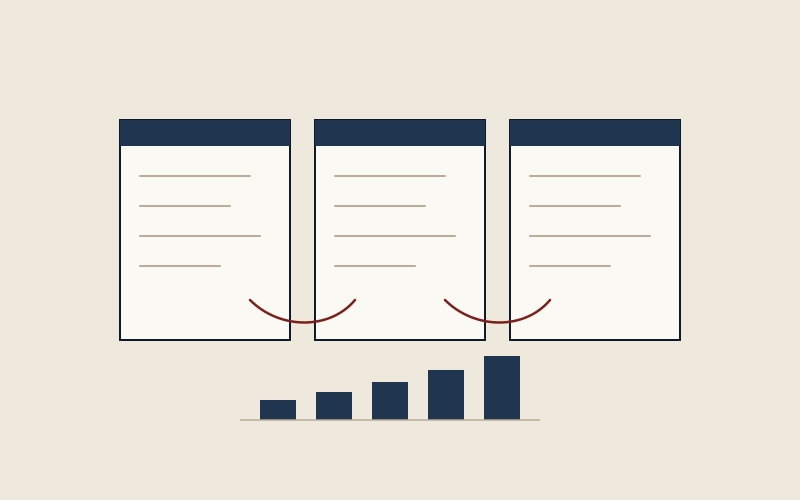
Business plans often consist only of income statement targets. When the working capital, capital expenditure and financing needs of growth do not appear in the balance sheet and cash flow, a plan that succeeds on paper becomes impossible to finance in practice.
Why it matters
Banks, lenders and shareholders look at whether a plan can be financed as much as at its profitability. Linking the three statements shows that the plan is internally consistent.
Approach
- Define revenue, cost, headcount and capital expenditure drivers by year.
- Link the income statement, balance sheet and cash flow to one set of assumptions, checking that the balance sheet balances every year.
- Derive the financing need from working capital and capital expenditure requirements.
- Compare base, upside and downside scenarios on the same model.
What it examines
- Driver-based revenue and cost projection
- Integrated income statement, balance sheet and cash flow
- Working capital and capital expenditure plan
- Financing need and debt capacity
- Scenario comparison
- Key ratios and management summary
Example output
Five-year summary financial statements, financing need by year and a scenario comparison table.
Limitations
- Five-year projections are inherently uncertain; assumptions should be updated regularly against actuals.
- The model does not replace a valuation exercise.
Related writing
-
-
Financial Management
Financial due diligence in acquisitions: what to examine
-
Financial Management
How to analyse an outsourcing decision